Tous droits réservés © NeurOreille (loi sur la propriété intellectuelle 85-660 du 3 juillet 1985). Ce produit ne peut être copié ou utilisé dans un but lucratif.
 Français
 English
 Español
 Português

We hear sounds: vibrations that spread in air or water and stimulate our ears.
In a natural environment, everything that vibrates creates a sound: leaves rustling in the wind, running water, violin or guitar strings, vocal cords…
What is sound ?
A sound wave is the vibration of air molecules around their resting state following the disruption of the surrounding environment, which can be solid, liquid or gaseous.
When the membrane of the speaker vibrates, the closer air molecules vibrate around their resting state and this vibration spreads to neighbouring molecules, and so on. After each environmental disruption, the air molecules return to their initial position: there is therefore no molecular displacement. This is what sound waves are.
Once captured by our ear, the vibrations cause the movement of the eardrum, the starting point for the ear’s stimulation and the perception of sound.
| |
Sound characteristics: frequency, intensity and duration
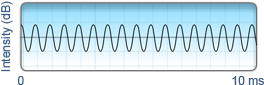
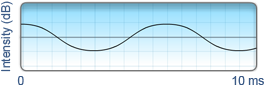
Frequency refers to the number of vibrations that occur per second: few vibrations produce a low sound, whereas more vibrations produce a higher sound. Frequency is measured in Hertz (Hz).
Intensity depends upon the amplitude of the vibrations: the bigger the amplitude, the louder the sound; and conversely, the smaller the amplitude, the quieter the sound. Intensity is commonly measured in decibels (dB).
Duration depends upon the length of time that the environment is disrupted. It is measured in seconds (s).
The human auditory range
Frequencies and intensities perceived by man are specific ( see next page)
High pitch sound
|
Low pitch sound
|
Environmental influences on sound
The speed of the soundwave
Soundwaves move at 340 m/s in air, 1500 m/s in water and at even higher speeds in denser materials (3500 m/s in bone and up to 6000 m/s in steel!). In a vacuum, with an absence of matter, sound does not propagate.
Example: if you put a sound source underneath a jar, you will hear the sound. However, if you create a vacuum underneath the jar, the sound disappears as there are no remaining air molecules to vibrate.
Other factors, such as the humidity levels or temperature, also influence the propagation speed of the soundwave.
Impedance
A soundwave can experience difficulties passing from one environment to another, as each environment imposes a resistance, which can vary in strength, called impedance. Therefore, a soundwave that propagates easily through air may be difficult to perceive in water, as the latter has a high impedance.
Example: at the beach, if you have your head under water, you won’t be able to hear the person that is speaking whilst walking along next to you. However, you’ll hear sounds produced under water perfectly well, such as the outboard motor of a boat that’s 100 m away!
A few common sounds
Pure tone
A pure tone is composed by a single frequency. Example: note A in music |
White noise
A white noise is a random signal containing an equal power of many frequencies. Example: gaslight, steamer. |
Music
A music sound is characterized by a fundamental frequency combined with harmonics, depending on the timber of the instrument. |
Voice
The voice is a complex sound. Each phoneme has a characteristic spectrum of frequencies, and everyone’s voice differs regarding pitch and timber. |


Hear four common sounds of our environment
Other properties linked to sound propagation
When a soundwave is produced, it will be modified by parameters such as distance, or potential obstacles.
- Attenuation: in free-field, a space where there are no obstacles to alter the soundwave, the acoustic intensity will decrease the further it gets from the sound source.
- Reflection: When a soundwave meets an obstacle, such as the ceiling of a room, a certain amount of the energy is bounced back into the room: this is reflection. Successive reflections make up reverberation.
- Absorption: Another amount of energy is partially absorbed by the ceiling itself: this occurs more readily for higher frequencies than for lower ones.
- Transmission: A part of the acoustic energy is transmitted into the next-door room through the ceiling, which acts like a secondary sound source.
Sound in a close environment
The sound of the drumkit bounces off of the walls and room dividers. One of the dividers is used as an example to show that some of the sound's energy is absorbed and the rest is transmitted. In the room next door, the remaining sound intensity depends upon the ceiling's absorbing ability. Theoretically, the sound will be quieter, otherwise the ceiling is inefficient.
| |
A few sound particularities
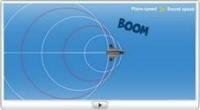
| Sonic boom |
The Doppler effect |
|

|
| The infinite gamme |
The Larsen effect: whistle |

|

|
(click on thumbnails)

Facebook Twitter Google+