Tous droits réservés © NeurOreille (loi sur la propriété intellectuelle 85-660 du 3 juillet 1985). Ce produit ne peut être copié ou utilisé dans un but lucratif.
 Français
 English
 Español
 Português

Auditory messages are conveyed to the brain via two types of pathway: the primary auditory pathway which exclusively carries messages from the cochlea, and the non-primary pathway (also called the reticular sensory pathway) which carries all types of sensory messages.
Primary auditory pathways
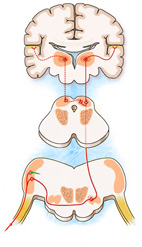
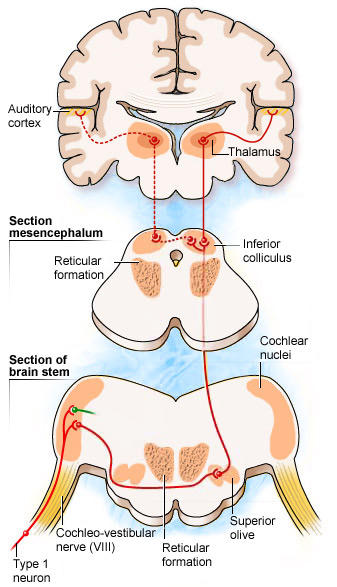
Schematically, this pathway is short (only 3 to 4 relays), fast (with large myelinated fibers), it ends in the primary auditory cortex. For details, see below. |
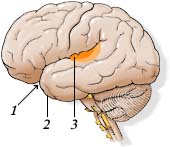
In human, the primary auditory cortex (3) is located in the temporal area (2) within the lateral sulcus (1). |
|
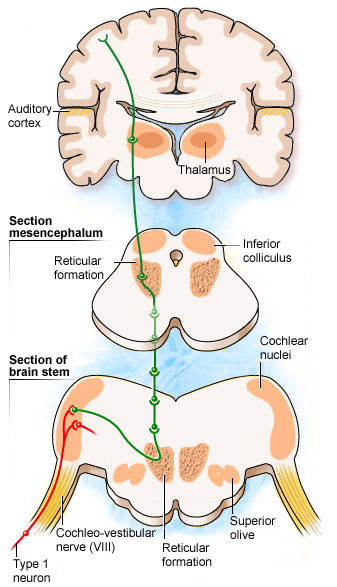
The first relay of the primary auditory pathway occurs in the cochlear nuclei in the brain stem, which receive Type I spiral ganglion axons (auditory nerve); at this level an important decoding of the basic signal occurs: duration, intensity and frequency. Leaving this relay, a third neuron carries the mesage up to the level of the inferior colliculus (mesencephalus ). These two relays play an essential rôle in the localisation of sound. A last relay, before the cortex, occurs in the medial geniculate body (thalamus ); it's here that an important integration occurs: preparation of a motor response (eg vocal response).
The final neuron of the primary auditory pathway links the thalamus to the auditory cortex, where the message, already largely decoded during its passage through the previous neurons in the pathway, is recognized, memorized and perhaps integrated into a voluntary response. |
Non-primary pathways
|
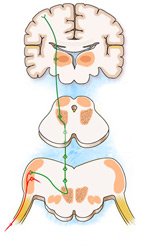
From the cochlear nuclei, small fibers connect with the reticular formation where the auditory message joins all other sensory messages. The next relay is in the non-specific thalamus nuclei before the pathway ends in the polysensory (associative) cortex. The main function of these pathways, also connected to wake and motivation centers as well as to vegetative and hormonal systems, is to select the type of sensory message to be treated first.
For instance, when reading a book while listening to a record, this system allows the person to pay attention alternately to the most important task. |
|
The first relay, in common with the primary auditory pathway, locates in the cochlear nuclei (brainstem). From there, the small fibers rejoin the ascending reticular pathway. In the reticular pathway of the brainstem and the mesencephalus, several synapses occur. It's here that the auditory information is integrated with all the other sensory modalities to be 'triaged' into which has the highest priority at any given moment. In other words, the reticular pathways participate with the wake and the motivation centres in selectioning the information that should be treated as priority by the brain. After the reticular formation, the non-primary pathway leads to the non-specific thalamus, then to the polysensory cortex.
Note: connections are also made with the hypothalamus and the vegetative centres (not shown on the diagram) |
Sensation and perception
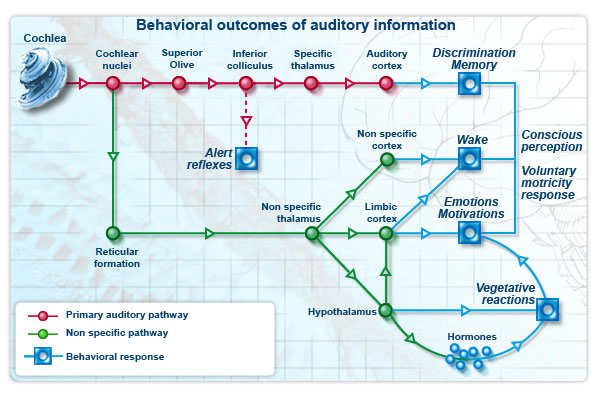
Conscious perception requires the integrity of both types of pathways.
For instance, during sleep the primary auditory pathway functions normally, but no conscious perception is possible because the link between reticular pathways and the wake and motivation centers is inactive.
Conversely, trauma affecting the cortex may suppress the conscious perception, while the continuing integrity of the non-primary pathways may result in vegetative reflex reactions to a sound. Also, because the brain stem and midbrain are intact, startle reflexes are still present.

Facebook Twitter Google+